For every claim that the term "racist" or "homophobe" is used to shut down legitimate debate, there seems to be a legitimate amount of covert bigotry from the accused.
Today, criticizing bigotry with calling it as it is, is almost as stigmatized as overt bigotry itself. You can't use the "N" word openly in debate just like you can't call the fence between America and Mexico racist. Hell, gay marriage opponents aren't even "homophobes" today. Instead they're "advocates for the sanctity of marriage." Because you know... people REALLY give a shit about the sanctity of marriage.
And racism is no longer racism. It's "black folks just need to pull themselves out of any situation their in despite any historical context which I chose to conveniently ignore." And as for their disproportional rate of poverty, it's simply because of their backwards culture. They have done it to themselves (sarcasm)!
I'm sorry but color blindness is just a modern day revival of the old racism. It's denying white privilege. It's denial of a history of racial slavery. To deny homosexuals the chance of marriage is to be fearful of homosexuality which is... by its very definition... "homophobia." There are ideas which many people hold and would still deny their own bigotry.
Don't mind me... I'm just playing the race/ gay/ woman card because... some people need to be called out on their shit.
Tuesday, July 24, 2012
Tuesday, March 6, 2012
As Long As We Don't Have to Self-Reflect
A few days ago, conservative radio talk show host Rush Limbaugh made a slut-shaming comment on air and liberals every where were up in arms with moral outrage. The poor PR this drew up resulted in his sponsors dropping him which in return resulted in his plea to save some of them... *cough* I mean his apology.
This leads me to wonder two things. First off, since when are liberals the bastion of hope for feminist issues? And two.. since when is Rush Limbaugh even relevant? Seriously, he's like the Cousin Skeeter of politics... except... you know... he is racist.
It's easier to be morally outraged at some old right-wing bigot than to look at yourself and check your own privilege. It's easier to hope that some corporate sponsors hit a rich man in his wallet where it hurts than to actually deal with the social issues at hand. Slut-shaming is as American as genocide... ehem... I mean apple pie and it's a big concern even to this day. Liberals are not immune to the misogyny that runs rampant in our society and the hypocrisy is almost embarrassing.
This leads me to wonder two things. First off, since when are liberals the bastion of hope for feminist issues? And two.. since when is Rush Limbaugh even relevant? Seriously, he's like the Cousin Skeeter of politics... except... you know... he is racist.
It's easier to be morally outraged at some old right-wing bigot than to look at yourself and check your own privilege. It's easier to hope that some corporate sponsors hit a rich man in his wallet where it hurts than to actually deal with the social issues at hand. Slut-shaming is as American as genocide... ehem... I mean apple pie and it's a big concern even to this day. Liberals are not immune to the misogyny that runs rampant in our society and the hypocrisy is almost embarrassing.
Saturday, March 3, 2012
Revolt, Flee or Submit
When faced with oppression, a person can either revolt, flee or submit. These would be in order from most difficult to easiest. I find it both sad and familiar to myself that we usually choose the easiest option.
Tuesday, February 21, 2012
A Personal Account of Past Insanity
For me, my own past has always had a weird relationship with my present-day self. Whether it be confusion over dreams of nostalgia or the recurring nightmares of my own past sheer insanity, it's sometimes hard to grasp the history of my own brain.
I guess, if one were to sum up my childhood they could say it was a collection of the most blissfully tragic memories of terrorizing school days and complete loneliness mixed with an over abundance of joy and passion. I would jump from one end to the other, sometimes within minutes.
Eventually I began to socialize with others more normally at around the time of 7th grade. That's when I sort of began my friendship building (and destroying) and learning how to really hang out with other people.
Without getting into too much detail about the more terrorizing stages of my mental state through childhood, I want to instead address the lows of my past and how they may still be relevant to today... or tomorrow for that matter. I don't want to live in these extremes. The euphoria doesn't compensate for the anxiety and I rather live on the middle ground to where I currently feel most comfortable at, because indulging in moderation is truly the way to go.
This leads me to my next worrisome thought. How will I leave this world? Will I fall back into my early mayhem stages? Where will it all take me? Thinking back makes me realize how important people are to me. And honestly... sometimes I don't feel that way. Sometimes I think I have my head on backwards and I'm just emotionally cut off from the world. If this were ever the case though, I don't know if I'd be ready to handle it if it was even possible. I don't think I'm willing to experiment with this.
I guess, if one were to sum up my childhood they could say it was a collection of the most blissfully tragic memories of terrorizing school days and complete loneliness mixed with an over abundance of joy and passion. I would jump from one end to the other, sometimes within minutes.
Eventually I began to socialize with others more normally at around the time of 7th grade. That's when I sort of began my friendship building (and destroying) and learning how to really hang out with other people.
Without getting into too much detail about the more terrorizing stages of my mental state through childhood, I want to instead address the lows of my past and how they may still be relevant to today... or tomorrow for that matter. I don't want to live in these extremes. The euphoria doesn't compensate for the anxiety and I rather live on the middle ground to where I currently feel most comfortable at, because indulging in moderation is truly the way to go.
This leads me to my next worrisome thought. How will I leave this world? Will I fall back into my early mayhem stages? Where will it all take me? Thinking back makes me realize how important people are to me. And honestly... sometimes I don't feel that way. Sometimes I think I have my head on backwards and I'm just emotionally cut off from the world. If this were ever the case though, I don't know if I'd be ready to handle it if it was even possible. I don't think I'm willing to experiment with this.
Monday, February 20, 2012
Stomp Someone Down the Nice Way
To just flat out kick somebody to the ground looks pretty bad, to say the least. It's a very bold way of keeping your minions in line. But if you would rather maintain a clean social image, a better way to lay down the law is to offer people two options with which both will lead to failure!
A certain failure can add legitimacy to your commands! And it works this way quite often. For example, take the witch hysteria from the older days. Back then, to test a woman to see if she was a witch or not, she would sometimes undergo a "swimming test." Basically what they would do is test to see if the woman in question was a witch or not, by seeing if she could breathe under water. If she could breathe under water she was guilty and if she drowned then she was innocent. She had two options, you see? She could... a) die or b) die. When you set up someone's fate like this, it isn't to offer justice or fairness. This was to create a system of hatred towards females. Witch hunting was the sport of misogyny!
Much like the older sport of misogyny, today a new sport is played and it's all dressed up for the 21st century. There is a new couple of options given to women these days. The first option is to be a "slut" which is a term given as much of a negative connotation as it is feminine. (Sure, one can be a "male slut" or a "man whore" but unlike a "fireman" or a "mailman," the "man" part of "man whore" diverges from the default definition of a "whore" usually being a woman.) The second option is to be a friend zoning, cold, frigid "bitch." So as a female... you can either put out and be shamed for your lack of self respect or you can turn a man down and be the girl who "friend zoned" her buddy. Either way, you lose! Misogyny!
And it's not just patriarchy that oppresses through lose/lose options. Government elections offer no solutions, our economy guarantees poverty, drug laws generate criminals... etc. etc. When the hand of oppression knocks us down, it's only doing its job.
A certain failure can add legitimacy to your commands! And it works this way quite often. For example, take the witch hysteria from the older days. Back then, to test a woman to see if she was a witch or not, she would sometimes undergo a "swimming test." Basically what they would do is test to see if the woman in question was a witch or not, by seeing if she could breathe under water. If she could breathe under water she was guilty and if she drowned then she was innocent. She had two options, you see? She could... a) die or b) die. When you set up someone's fate like this, it isn't to offer justice or fairness. This was to create a system of hatred towards females. Witch hunting was the sport of misogyny!
Much like the older sport of misogyny, today a new sport is played and it's all dressed up for the 21st century. There is a new couple of options given to women these days. The first option is to be a "slut" which is a term given as much of a negative connotation as it is feminine. (Sure, one can be a "male slut" or a "man whore" but unlike a "fireman" or a "mailman," the "man" part of "man whore" diverges from the default definition of a "whore" usually being a woman.) The second option is to be a friend zoning, cold, frigid "bitch." So as a female... you can either put out and be shamed for your lack of self respect or you can turn a man down and be the girl who "friend zoned" her buddy. Either way, you lose! Misogyny!
And it's not just patriarchy that oppresses through lose/lose options. Government elections offer no solutions, our economy guarantees poverty, drug laws generate criminals... etc. etc. When the hand of oppression knocks us down, it's only doing its job.
Tuesday, February 14, 2012
Equality Within Communism
What does "communist equality" sound like to a capitalist? Well, it probably sounds like a place where everyone wears the exact same uniform and marches to the exact same drum beat in an impoverished nation under the guise of a merciless regime. You've got to love that Cold War propaganda!
To be fair however, capitalism to me sounds like a country full of micro-dictatorships where all the workers serve their masters while wearing identical uniforms and listening to the same corporate radio stations. Actually, that's based more so on my real-life experience though and not just propaganda and rhetoric.
You see, to imagine that one could desire equality while also embracing an elite ruling party is such a contradicting concept that if I were to try and make sense of it my brain would probably go through a melt down. And capitalists pride themselves in opportunistic equality because anyone could some day make it to the top and have their own glorious enterprise dominion. It's such a beautiful thing when the exploited take their unprivileged opportunity of social mobility and become the exploiters. (Was the sarcasm apparent enough??)
All jokes cast aside, equality in reward for labor in no way implies equality OF the types of labor. When labor becomes enjoyable and non-oppressive, it becomes an honest obligation rather than a burden to the individual. And of course equality of reward doesn't imply no specialization. No one ever said that everyone is expected to know everything. A logical division of labor does not imply an irrational inequality in living standards.
To be fair however, capitalism to me sounds like a country full of micro-dictatorships where all the workers serve their masters while wearing identical uniforms and listening to the same corporate radio stations. Actually, that's based more so on my real-life experience though and not just propaganda and rhetoric.
You see, to imagine that one could desire equality while also embracing an elite ruling party is such a contradicting concept that if I were to try and make sense of it my brain would probably go through a melt down. And capitalists pride themselves in opportunistic equality because anyone could some day make it to the top and have their own glorious enterprise dominion. It's such a beautiful thing when the exploited take their unprivileged opportunity of social mobility and become the exploiters. (Was the sarcasm apparent enough??)
All jokes cast aside, equality in reward for labor in no way implies equality OF the types of labor. When labor becomes enjoyable and non-oppressive, it becomes an honest obligation rather than a burden to the individual. And of course equality of reward doesn't imply no specialization. No one ever said that everyone is expected to know everything. A logical division of labor does not imply an irrational inequality in living standards.
Thursday, February 9, 2012
Religion Is Merely A Tool Of Convenience
Today as I was reading some online essay on Reducing the Ego (http://www.taoism.net/theway/ego.htm), which was correlating Taoism to the idea of minimizing your own "false self-image" (ego), I had wondered, "Who would be inclined to actually read into Taoism?" Would an egomaniac be inclined to read about destroying their own ego? Would a humble person be inclined to read about boosting the ego? In all honesty, it seems that people with certain tendencies would be naturally swayed towards a familiar philosophy.
Like many religions however, Taoism has also been cherry picked by people with all sorts of tendencies. Some claim it is critical of competitiveness while others have written articles on Taoism supporting a laissez-faire system (free market capitalism). Also, consider how religion has been used in cases of civil rights. The same religion that influenced Martin Luther King Jr. to struggle against defacto, racial segregation in the south also influenced others to support slavery prior to that (http://www.religioustolerance.org/chr_slav1.htm).
For these and other examples of contradicting beliefs stemming from single religions, I want to correct my previous claim that Christianity itself "influenced" MLK. Christianity really didn't influence anything for the most part. It was just used (and still is to this day) as a tool of convenience. It's just a toy box of moral scriptures that people dig into to find what ever matches their already preconceived notions of morality. These preconceived notions of morality stem from culture and education.
This leads me to another worrisome observation. It seems that within the atheist trends today, some anti-theists flirt with the idea of ethnocentrism. The thought goes, "Christianity has done plenty to harm LGBT civil rights in western society, but we're still better off than the Muslim nations who embrace Sharia Law to the east." Ethnocentrism isn't exclusive to atheists, but it does unfortunately get thrown in with the criticism of all religions. This is why it is important to recognize that culture creates religion and morality and not the other way around. Both western and eastern cultures have been shaped by domination culture and various political conflicts and colonization (and the limitations that have been put into place by these factors) have been the leading influences on morality.
To conclude all of these observations, I would just like to state that religion is really an illusion in more ways than one... especially in politics. Religion is just a tool people use to rally in supporters. "I believe this and SO DOES GOD!" It's all tied in to the idea that our ideologies and tendencies should dominate and control populations of people. If one is to reject religion, one should also reject its significance.
Like many religions however, Taoism has also been cherry picked by people with all sorts of tendencies. Some claim it is critical of competitiveness while others have written articles on Taoism supporting a laissez-faire system (free market capitalism). Also, consider how religion has been used in cases of civil rights. The same religion that influenced Martin Luther King Jr. to struggle against defacto, racial segregation in the south also influenced others to support slavery prior to that (http://www.religioustolerance.org/chr_slav1.htm).
For these and other examples of contradicting beliefs stemming from single religions, I want to correct my previous claim that Christianity itself "influenced" MLK. Christianity really didn't influence anything for the most part. It was just used (and still is to this day) as a tool of convenience. It's just a toy box of moral scriptures that people dig into to find what ever matches their already preconceived notions of morality. These preconceived notions of morality stem from culture and education.
This leads me to another worrisome observation. It seems that within the atheist trends today, some anti-theists flirt with the idea of ethnocentrism. The thought goes, "Christianity has done plenty to harm LGBT civil rights in western society, but we're still better off than the Muslim nations who embrace Sharia Law to the east." Ethnocentrism isn't exclusive to atheists, but it does unfortunately get thrown in with the criticism of all religions. This is why it is important to recognize that culture creates religion and morality and not the other way around. Both western and eastern cultures have been shaped by domination culture and various political conflicts and colonization (and the limitations that have been put into place by these factors) have been the leading influences on morality.
To conclude all of these observations, I would just like to state that religion is really an illusion in more ways than one... especially in politics. Religion is just a tool people use to rally in supporters. "I believe this and SO DOES GOD!" It's all tied in to the idea that our ideologies and tendencies should dominate and control populations of people. If one is to reject religion, one should also reject its significance.
Sunday, January 22, 2012
Internet's Anarchy vs. Domination Culture
Because life outside of the Internet was in many ways bleak, riddled with alienation and lacked any real sense of community, many people became addicted to the Internet and spent countless hours floating through a seemingly lawless cyber space.
Now back in the real world, folks for the most part were still unaware of their own class consciousness and they went on their ways while going through the motions of a typical day of corporate slavery and doing as they were told. But as foreshadowing would have it, the Governments and their corporations grew wary as to what their little minions were up to in their little private online communities. "Too much talking and file sharing going on," Mr. Corporation said to Mr. Government. "Maybe we need to lay down a little law within their cyber utopias."
Being as how the Internet was the only real sense of community and freedom that the average citizens were allowed to experience, once they realized their online worlds were in jeopardy they began to buzz like an angry bee-hive. Suddenly the realization of corporate and government tyranny would clash with true freedom and community.
Now the only question left is... will the Internet share the same fate as the worker in chains? One can only speculate as the people will probably run to their corporate masters and seek what little solidarity and voice they do have against government mandates and imprisonment of their Internet.
Tuesday, December 27, 2011
Common Misconceptions Among Anti-Feminist MRA's
Mens' rights advocates often have a general idea of the problems associated with gender roles, but as TJ (aka The Amazing Atheist) points out... the overall concept flies over their heads.
The specific issues that are brought up by MRA's that supposedly disempower males are usually actually further evidence that patriarchy is still alive and well within our country.
To put gender issues into context, you must first realize what patriarchy is. It's instilled attitudes towards both genders which ultimately favor male domination. With the set notion that females are weaker, it's actually no surprise that when domestic abuse is caused by the woman, it's not taken as seriously. The main role of the woman in society is to be the damsel in distress and when the helpless damsel ends up being the abuser then the male victim is more likely to be seen as weak and/ or the issue isn't taken with proper consideration. This idea of the dominating/ strong male is also another reason why patriarchy plays as a disadvantage to homosexuals. Sexism = Homophobia.
So yes... when a man takes on the role of being submissive, weak, indecisive (all traits to which a patriarchal society lends to the female gender) then he is indeed disadvantaged because patriarchy seeks to keep male domination intact. When the courts side more often with women in child custody battles it's because the general attitude is that women belong more so at home raising the child (while the male should be out making the money to support his family).
As for the issue which TJ brings up with circumcision, I would argue that that's more of a childs' rights issue. Societies have plenty of overlapping domination structures and one of them is the nonconsensual violence used against children (corporal punishment, circumcisions... etc).
While it is a nice thought that MRA's do recognize gender inequality and specific roles, the main basis for all these roles (patriarchy) is overlooked and therefor misunderstood.
The specific issues that are brought up by MRA's that supposedly disempower males are usually actually further evidence that patriarchy is still alive and well within our country.
To put gender issues into context, you must first realize what patriarchy is. It's instilled attitudes towards both genders which ultimately favor male domination. With the set notion that females are weaker, it's actually no surprise that when domestic abuse is caused by the woman, it's not taken as seriously. The main role of the woman in society is to be the damsel in distress and when the helpless damsel ends up being the abuser then the male victim is more likely to be seen as weak and/ or the issue isn't taken with proper consideration. This idea of the dominating/ strong male is also another reason why patriarchy plays as a disadvantage to homosexuals. Sexism = Homophobia.
So yes... when a man takes on the role of being submissive, weak, indecisive (all traits to which a patriarchal society lends to the female gender) then he is indeed disadvantaged because patriarchy seeks to keep male domination intact. When the courts side more often with women in child custody battles it's because the general attitude is that women belong more so at home raising the child (while the male should be out making the money to support his family).
As for the issue which TJ brings up with circumcision, I would argue that that's more of a childs' rights issue. Societies have plenty of overlapping domination structures and one of them is the nonconsensual violence used against children (corporal punishment, circumcisions... etc).
While it is a nice thought that MRA's do recognize gender inequality and specific roles, the main basis for all these roles (patriarchy) is overlooked and therefor misunderstood.
Saturday, December 3, 2011
Abuse of Authority? I Am Not Amused
There are so many stories in the news, all day and every day, about people in power abusing their authority in some way. And every time it's, "Oh my God! How could this incident have happened!?" as if this is just some isolated occurence.
No, this is not an isolated incident. These are merely reccuring episodes of corruption generated from a system that was started, maintained and continuously produces violence in one of its various forms. And no, I'm not going to be surprised if the Occupy movement ends up having their own Kent State Massacre. It's actually rather vain of any country to raise hell over the loss of unarmed citizens while their armies commit Kent State Massacres all over the globe in other countries.
Sunday, November 20, 2011
The Line Between Discipline and Child Abuse
There's been many times where I've been in one of these conversations:
"If I ever dared to talk back to my daddy, he would whoop my ass with a belt!"
There just must be something reviving in telling a story about childhood beatings that really sends a glistening glimmer in someone's eyes. It's almost as if to imply that "Those were the good ole days!" and parents today are just "too soft" or "afraid of their own children."
Around 1870 in the USA, beating your wife was officially made illegal. But what if instead... wife beating was legal, but you just couldn't leave a mark? What if we used child disciplinary laws as every day rules for daily interactions? And what exactly does it mean to draw the line between discipline and child abuse at leaving a mark? Why is leaving that mark so much worse than not leaving it? Is it because other people who see your child shouldn't be aware of the violence?
Hitting your child, in my opinion, doesn't look like a behavior problem for the child, it looks like a behavior problem of the parent. It looks to me as if the parent has lost control of their situation and decided to resort to violence. And this goes for spanking too. Which is another thing to wonder. Why is the butt the least tabboo place to hit a child? Seems to me that this is just a cultural norm that we use to feel better about hitting our children and to justify these actions.
Besides for the physical suffering of children who receive corporal punishment, studies also indicate that spanking lowers a child's IQ (http://psychcentral.com/news/2009/09/27/spanked-children-have-lower-iq/8620.html). Knowing this, I can't imagine why parents would want to risk their child's mental development all because they feel the need to project their aggression onto their kids through violence.
The fact of the matter is, children are people too. They're growing, naive, short little people with (hopefully) a long life ahead of them. In our society, witnessing violence first-hand is inevitable but there really is no need to introduce your kid to it right off the bat and pass on traditions of abuse. There should however be drawn a line. That line should separate a non-violent parent-to-child relationship to a violent one. No more "let's hide the abuse by not leaving a mark" or "just hit your child on the butt" or any other poor excuse to rid yourself of any guilt you may find yourself with after hurting your kid.
Is this taking a "too soft" approach to parenting? Is this just "telling you how to raise your kids"? Well, what some would consider "too soft," I would consider "social evolution" in progress. And I couldn't stop you from hitting your child just like I couldn't stop you from beating your spouse, but if advocating a violent-free relationship with your loved ones seems overly intrusive... then I can only apologize for suggesting a more loving relationship.
Lastly, there are alternatives to violence! For instance, using humor is a great way to discipline your child without expressing pain, revenge and agony. This is a great article that gives more detail: http://children.webmd.com/features/child-discipline
"If I ever dared to talk back to my daddy, he would whoop my ass with a belt!"
There just must be something reviving in telling a story about childhood beatings that really sends a glistening glimmer in someone's eyes. It's almost as if to imply that "Those were the good ole days!" and parents today are just "too soft" or "afraid of their own children."
Around 1870 in the USA, beating your wife was officially made illegal. But what if instead... wife beating was legal, but you just couldn't leave a mark? What if we used child disciplinary laws as every day rules for daily interactions? And what exactly does it mean to draw the line between discipline and child abuse at leaving a mark? Why is leaving that mark so much worse than not leaving it? Is it because other people who see your child shouldn't be aware of the violence?
Hitting your child, in my opinion, doesn't look like a behavior problem for the child, it looks like a behavior problem of the parent. It looks to me as if the parent has lost control of their situation and decided to resort to violence. And this goes for spanking too. Which is another thing to wonder. Why is the butt the least tabboo place to hit a child? Seems to me that this is just a cultural norm that we use to feel better about hitting our children and to justify these actions.
Besides for the physical suffering of children who receive corporal punishment, studies also indicate that spanking lowers a child's IQ (http://psychcentral.com/news/2009/09/27/spanked-children-have-lower-iq/8620.html). Knowing this, I can't imagine why parents would want to risk their child's mental development all because they feel the need to project their aggression onto their kids through violence.
The fact of the matter is, children are people too. They're growing, naive, short little people with (hopefully) a long life ahead of them. In our society, witnessing violence first-hand is inevitable but there really is no need to introduce your kid to it right off the bat and pass on traditions of abuse. There should however be drawn a line. That line should separate a non-violent parent-to-child relationship to a violent one. No more "let's hide the abuse by not leaving a mark" or "just hit your child on the butt" or any other poor excuse to rid yourself of any guilt you may find yourself with after hurting your kid.
Is this taking a "too soft" approach to parenting? Is this just "telling you how to raise your kids"? Well, what some would consider "too soft," I would consider "social evolution" in progress. And I couldn't stop you from hitting your child just like I couldn't stop you from beating your spouse, but if advocating a violent-free relationship with your loved ones seems overly intrusive... then I can only apologize for suggesting a more loving relationship.
Lastly, there are alternatives to violence! For instance, using humor is a great way to discipline your child without expressing pain, revenge and agony. This is a great article that gives more detail: http://children.webmd.com/features/child-discipline
Tuesday, November 1, 2011
Urban Farming As A Means To A Better Society
(I've written about this before, but I thought I'd throw the concept onto this blog as well.)
If you look at a map with all of the various political beliefs in specific regions, usually what you'll find is that the big cities are more progressive while rural places tend to stay more conservative. Long story short... individual isolation stunts human progress. This is why, to me, it doesn't seem like a far stretch to suggest that the bulk of society should work towards condensing itself into certain areas.
Now let's say one were to buy into this pretense but then asks, "How do we cram society together to promote social progress?" That is precisely where urban farming comes into play. Furthermore, it's also a call to eliminate rural farming all together.
Reasons to eliminate rural farming:
1) Inefficient.
2) Weather dependent.
3) Stunts social progress.
4) Waste of land space.
Urban farming would serve as a better alternative because instead of depending on the weather to dictate the seasons in which we expect our foods, we could focus on building artificial climates to provide the ability to grow any food, any where and at any time of the year. Also, if we instead crammed these "urban farms" into buildings, we wouldn't rely on vast lands to produce our food.
If we could control the environment we would eliminate the need for pesticides. Healthier fruits, healthier people! And on that note with the environment, if society was condensed into smaller regions because of urban farming, that would be a great incentive for alternative energies to keep these small places nice and clean. Think also about all of the extra land this would free up. This could potentially be used as a way to also promote nature conservancy in certain places.
Suddenly, everyone lives in closer quarters with each other, society becomes more aware of itself and others, progress thrives, unity and community are strengthened and everyone has easier access to locally grown veggies.
How do we get this started? With today's economic powers waving over the heads of all the citizens, I really am not sure how to implement this strategy. I personally tend to live in a dream world where I can fathom communities self-organizing to better themselves and their own standards. It's hard to really say where capitalism will take us from our current point in time. Even to those who would argue that the state also plays too big of a role in our market... either way, the status-quo (however one would interpret it to be) doesn't really seem to be open to this idea at the moment. But maybe one day...
If you look at a map with all of the various political beliefs in specific regions, usually what you'll find is that the big cities are more progressive while rural places tend to stay more conservative. Long story short... individual isolation stunts human progress. This is why, to me, it doesn't seem like a far stretch to suggest that the bulk of society should work towards condensing itself into certain areas.
Now let's say one were to buy into this pretense but then asks, "How do we cram society together to promote social progress?" That is precisely where urban farming comes into play. Furthermore, it's also a call to eliminate rural farming all together.
Reasons to eliminate rural farming:
1) Inefficient.
2) Weather dependent.
3) Stunts social progress.
4) Waste of land space.
Urban farming would serve as a better alternative because instead of depending on the weather to dictate the seasons in which we expect our foods, we could focus on building artificial climates to provide the ability to grow any food, any where and at any time of the year. Also, if we instead crammed these "urban farms" into buildings, we wouldn't rely on vast lands to produce our food.
If we could control the environment we would eliminate the need for pesticides. Healthier fruits, healthier people! And on that note with the environment, if society was condensed into smaller regions because of urban farming, that would be a great incentive for alternative energies to keep these small places nice and clean. Think also about all of the extra land this would free up. This could potentially be used as a way to also promote nature conservancy in certain places.
Suddenly, everyone lives in closer quarters with each other, society becomes more aware of itself and others, progress thrives, unity and community are strengthened and everyone has easier access to locally grown veggies.
How do we get this started? With today's economic powers waving over the heads of all the citizens, I really am not sure how to implement this strategy. I personally tend to live in a dream world where I can fathom communities self-organizing to better themselves and their own standards. It's hard to really say where capitalism will take us from our current point in time. Even to those who would argue that the state also plays too big of a role in our market... either way, the status-quo (however one would interpret it to be) doesn't really seem to be open to this idea at the moment. But maybe one day...
Tuesday, October 18, 2011
Hyper-Capitalists Monopolize In the Bullshit Market
There's many ironic things about hyper-capitalists. I use the term "hyper-capitalist" as an umbrella term in reference to right-wing "libertarians," economic conservatives and anarcho-capitalists. Besides for their unwavering support of unchecked bureaucratic power to go along with their "Don't Tread On Me" slogans, their laissez-fairy tales don't stop short of conspiracy theories and a complete disregard for class inequalities and privileges.
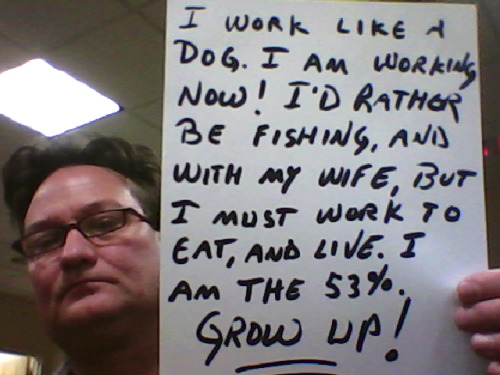
Recently, I was checking out the whole "53%" hubbub on Tumblr and how people were saying that the images on there were fake. First off, we have to look past the absurdity that lies within some of those posts to begin with.
People have supposedly been posting up these horribly depressing stories about working "like a dog" to earn what little money they do have just to survive. This is all meant to say, "America... fuck yeah!" but it looks more to me like a somber celebration from a bunch of wage-slaves. This all makes me wonder too if during the days of African slavery in America, if they could've polled the slaves... I wonder how many of them would've agreed that slavery is good because at least they get their food after a hard day's work.
Any ways, the point of this all is that if these are actually made up (to at least a certain degree).. that's completely pathetic and antithetical to their "movement." It's stupid in the same way that Alex Jones (right-wing nut extraordinaire) lies to all his listeners on his radio show blatantly every episode. It's stupid in the same way that all of Ron Paul's followers ignore his stances on race and abortion.
I've come to the conclusion lately, that hyper-capitalists love to make up bullshit. They passed a law in 2006 that would try to destroy the public-sector US Post Office by making them pay "annual $5.5 billion payments to fund 75 years of future retirement packages" (http://www.pittsfield.com/story/39520/Postal-Services-Rally-For-New-Pension-Bill.html). If the public-sector works, purposely make it fail because umm... COMMUNISM SUCKS!!!
Oh yeah.. and anarcho-capitalists also love to make up stories in the form of science-fiction novels. http://en.wikipedia.org/wiki/Anarcho-capitalist_literature#Fiction
Recently, I was checking out the whole "53%" hubbub on Tumblr and how people were saying that the images on there were fake. First off, we have to look past the absurdity that lies within some of those posts to begin with.
People have supposedly been posting up these horribly depressing stories about working "like a dog" to earn what little money they do have just to survive. This is all meant to say, "America... fuck yeah!" but it looks more to me like a somber celebration from a bunch of wage-slaves. This all makes me wonder too if during the days of African slavery in America, if they could've polled the slaves... I wonder how many of them would've agreed that slavery is good because at least they get their food after a hard day's work.
Any ways, the point of this all is that if these are actually made up (to at least a certain degree).. that's completely pathetic and antithetical to their "movement." It's stupid in the same way that Alex Jones (right-wing nut extraordinaire) lies to all his listeners on his radio show blatantly every episode. It's stupid in the same way that all of Ron Paul's followers ignore his stances on race and abortion.
I've come to the conclusion lately, that hyper-capitalists love to make up bullshit. They passed a law in 2006 that would try to destroy the public-sector US Post Office by making them pay "annual $5.5 billion payments to fund 75 years of future retirement packages" (http://www.pittsfield.com/story/39520/Postal-Services-Rally-For-New-Pension-Bill.html). If the public-sector works, purposely make it fail because umm... COMMUNISM SUCKS!!!
Oh yeah.. and anarcho-capitalists also love to make up stories in the form of science-fiction novels. http://en.wikipedia.org/wiki/Anarcho-capitalist_literature#Fiction
Tuesday, October 11, 2011
The Occupy Movement Is A Perfect Example of a Stateless Society
The correlation between the Occupy movement and a stateless society based on collective relationships is almost piece by piece, a perfect match.
For starters, there's the spontaneous organization. Like many movements, Occupy Wall Street triggered cities all over the USA (and now beyond) to form organizations. The great part about this also, is that the internal structure lacks a hierarchy. Just like a worker's co-op, the Occupy movement consciously avoids top-down tyranny by advancing its purpose through democratic decisions.
In addition, the only true threat to the Occupy movement IS top-down hierarchy. Those threats would mostly be from police crack downs to partisan sabotage (for instance, letting a Democrat or right-wing Libertarian hijack its message).
Anyways, I was browsing Reddit (as usual) the other day and of course there was some post where some naive (most likely a liberal) Occupier was going off about anarchists sabotaging the movement or at least making too much of an embarrassing presence. I'm sorry, but there's just a laughable amount of irony in a tyranny-apologist's complaint about a democratic movement being hijacked by anarchists. If this movement is under threat by anything, it's the Don't Tread On Me and Obama crowd who would sell themselves short on the dime just to make a little reform in a broken system. A system which secures property rights for private tyrannies and maintains oppression through police force.
So please... dear liberals of America. For the love of all that's good in this world, stop comparing anarchism to chaos when the system that your party has favored has caused more chaos than any single person could ever hope or wish for.
For starters, there's the spontaneous organization. Like many movements, Occupy Wall Street triggered cities all over the USA (and now beyond) to form organizations. The great part about this also, is that the internal structure lacks a hierarchy. Just like a worker's co-op, the Occupy movement consciously avoids top-down tyranny by advancing its purpose through democratic decisions.
In addition, the only true threat to the Occupy movement IS top-down hierarchy. Those threats would mostly be from police crack downs to partisan sabotage (for instance, letting a Democrat or right-wing Libertarian hijack its message).
Anyways, I was browsing Reddit (as usual) the other day and of course there was some post where some naive (most likely a liberal) Occupier was going off about anarchists sabotaging the movement or at least making too much of an embarrassing presence. I'm sorry, but there's just a laughable amount of irony in a tyranny-apologist's complaint about a democratic movement being hijacked by anarchists. If this movement is under threat by anything, it's the Don't Tread On Me and Obama crowd who would sell themselves short on the dime just to make a little reform in a broken system. A system which secures property rights for private tyrannies and maintains oppression through police force.
So please... dear liberals of America. For the love of all that's good in this world, stop comparing anarchism to chaos when the system that your party has favored has caused more chaos than any single person could ever hope or wish for.
Thursday, September 22, 2011
Workplace Democracy As A Means To A Paradigm Shift Among Social Relationships
I've recently started designing a pamphlet. I've actually finished it but I just need to figure out how to more efficiently produce and distribute it. It's a pamphlet containing brief information on workplace exploitation and the worker-run solution.
Anyways, I was sort of proud from breaking out of my debilitating habit of being online all day and not being very productive at all with my free time.
The reason why I personally focus on worker liberation (as opposed to sexual, racial and other forms) is because workers are a very general portion of the population which unknowingly face oppression each day. I say "unknowingly" because the oppression is seen as more of an individualistic issue rather than a collective issue of all of today's wage slaves. Ignoring the systemic issue of corporate oppression helps maintain the exploitation by sending the message "If you're unhappy at your job, you just need to find a better job." rather than admitting that the entire capitalist economic system is comprised of jobs that offer no chance of worker-control and workplace democracy.
So I would argue that the main goal of educating people (who are usually workers themselves) about workplace democracy is to make the giant leap from a culture of exploitation and domination to a more egalitarian and democratic society. Once the playing field is some what leveled out, then people may be more willing to recognize each others' issues such as male dominance, racial domination and other forms of societal inequalities that coexist with workplace domination.
Currently it seems, the cultural climate mixed with capitalist domination only allows for so much breathing room. There's only so much time to self reflect and resist within the time frame of a worker who has a full-time job or is carrying multiple jobs to meet the needs of their own survival. And in between the moments of being dominated in the workplace, the average person is tempted with entertainment and various distractions to consume their free time. Even if the average worker didn't indulge his or her free time with fun, the general attitude of individual success would still make them feel obligated to continue the system as it currently stands rather than fight back.
That's why the only non-governmental, logical and non-coercive step towards liberation would be to educate. Get people fired up about the issue of workplace democracy. Raise awareness in peoples' minds as to their true potential in their company. If there is no culture of resistance then there will be no progress and the cycles of generations to come will continue to be plagued with an economy that never gave them a chance.
Anyways, I was sort of proud from breaking out of my debilitating habit of being online all day and not being very productive at all with my free time.
The reason why I personally focus on worker liberation (as opposed to sexual, racial and other forms) is because workers are a very general portion of the population which unknowingly face oppression each day. I say "unknowingly" because the oppression is seen as more of an individualistic issue rather than a collective issue of all of today's wage slaves. Ignoring the systemic issue of corporate oppression helps maintain the exploitation by sending the message "If you're unhappy at your job, you just need to find a better job." rather than admitting that the entire capitalist economic system is comprised of jobs that offer no chance of worker-control and workplace democracy.
So I would argue that the main goal of educating people (who are usually workers themselves) about workplace democracy is to make the giant leap from a culture of exploitation and domination to a more egalitarian and democratic society. Once the playing field is some what leveled out, then people may be more willing to recognize each others' issues such as male dominance, racial domination and other forms of societal inequalities that coexist with workplace domination.
Currently it seems, the cultural climate mixed with capitalist domination only allows for so much breathing room. There's only so much time to self reflect and resist within the time frame of a worker who has a full-time job or is carrying multiple jobs to meet the needs of their own survival. And in between the moments of being dominated in the workplace, the average person is tempted with entertainment and various distractions to consume their free time. Even if the average worker didn't indulge his or her free time with fun, the general attitude of individual success would still make them feel obligated to continue the system as it currently stands rather than fight back.
That's why the only non-governmental, logical and non-coercive step towards liberation would be to educate. Get people fired up about the issue of workplace democracy. Raise awareness in peoples' minds as to their true potential in their company. If there is no culture of resistance then there will be no progress and the cycles of generations to come will continue to be plagued with an economy that never gave them a chance.
Saturday, February 19, 2011
Survival and Anarchy
Life has a way of providing a balance, consequences and yet... no real justice. It provides struggles, solutions and no guarantees. For instance... sexually transmitted diseases lay hazard to the unfaithful, promiscuous and careless, yet MANY people who have STD's weren't necessarily living the life of a sexually active person. Over indulge in the pleasures of food? Life hands you high cholesterol, obesity and the increased risk of a heart attack. Yet there are many people who've died of heart attacks who may not have even been overweight. The risks are always prevalent.
So here we are, seeing ourselves constantly threatened with our own survival. People, for the sake of their own survival, will retaliate when their safety is threatened by another. For example, if I were to go around punching people... eventually someone would try to fight back and could even potentially kill me. In a way, life just sort of works out to keep things at a certain (yet unpredictable) balance.
What's really fascinating is the various ways different societies cope with this inevitable survival that we all struggle with. Human relations power is a part of this balance in life. You're as powerful as I am, so I empathize your struggle. We lay equal risk to each other and there for... we find ourselves at a mutual understanding.
Of course, with power, comes the obvious problem of hierarchy. If I'm a human and you're an ant... where's my incentive not to squash you? Will your ant friends get mad and try to bite me? I can just kill your entire family for fun and then enjoy the rest of my day. Matter of fact, it's interesting to note that humans are by far the smartest animal on the planet which places us at the top of the food chain (nature's hierarchy of survival) which gives us little, if any, incentive not to eat all the animals below us. Again... life provides no certainty and occasionally an animal may kill a person.
The reason for mentioning the person killing an ant scenario is to make an analogy of hierarchies with human interactions. Our natural incentive to empathize with people of equal ranking of ourselves is thrown off track when one person places themselves on top of another. This is why state leaders are often quick to go to war. There is no empathy for peasants in far away lands. There is little to no empathy for a state leader's own citizens (their only motivation to be nice is in a representative democracy where their own lust for power is threatened by majority rule).
Perhaps the only reason that the notion of anarchism isn't a highly celebrated world view today is because people feel threatened by hierarchy. That's right... people are afraid of anarchy (a lack of hierarchy) because they're afraid of hierarchy itself. "Who protects me from the bullies?" Here's the part that most people don't get though. There is something known as a collective power. Collective power as a whole is stronger than any individual... yet collective power wouldn't wield violence on itself because... well... that would defeat the purpose of the whole notion of survival.
A society based on collective power could regulate itself because it would create a communal sense of survival. If you don't believe this to be true... next time you have a family gathering... just start punching the shit out of one of your relatives and see if your family cheers you (the bully) on as your grandmother lays on the floor in a pool of blood.
Cooperation and collective power is the only way we can really survive in this world if we want to live in further safety.
So here we are, seeing ourselves constantly threatened with our own survival. People, for the sake of their own survival, will retaliate when their safety is threatened by another. For example, if I were to go around punching people... eventually someone would try to fight back and could even potentially kill me. In a way, life just sort of works out to keep things at a certain (yet unpredictable) balance.
What's really fascinating is the various ways different societies cope with this inevitable survival that we all struggle with. Human relations power is a part of this balance in life. You're as powerful as I am, so I empathize your struggle. We lay equal risk to each other and there for... we find ourselves at a mutual understanding.
Of course, with power, comes the obvious problem of hierarchy. If I'm a human and you're an ant... where's my incentive not to squash you? Will your ant friends get mad and try to bite me? I can just kill your entire family for fun and then enjoy the rest of my day. Matter of fact, it's interesting to note that humans are by far the smartest animal on the planet which places us at the top of the food chain (nature's hierarchy of survival) which gives us little, if any, incentive not to eat all the animals below us. Again... life provides no certainty and occasionally an animal may kill a person.
The reason for mentioning the person killing an ant scenario is to make an analogy of hierarchies with human interactions. Our natural incentive to empathize with people of equal ranking of ourselves is thrown off track when one person places themselves on top of another. This is why state leaders are often quick to go to war. There is no empathy for peasants in far away lands. There is little to no empathy for a state leader's own citizens (their only motivation to be nice is in a representative democracy where their own lust for power is threatened by majority rule).
Perhaps the only reason that the notion of anarchism isn't a highly celebrated world view today is because people feel threatened by hierarchy. That's right... people are afraid of anarchy (a lack of hierarchy) because they're afraid of hierarchy itself. "Who protects me from the bullies?" Here's the part that most people don't get though. There is something known as a collective power. Collective power as a whole is stronger than any individual... yet collective power wouldn't wield violence on itself because... well... that would defeat the purpose of the whole notion of survival.
A society based on collective power could regulate itself because it would create a communal sense of survival. If you don't believe this to be true... next time you have a family gathering... just start punching the shit out of one of your relatives and see if your family cheers you (the bully) on as your grandmother lays on the floor in a pool of blood.
Cooperation and collective power is the only way we can really survive in this world if we want to live in further safety.
Tuesday, January 11, 2011
"Top Down Prison Land"
Intro:
This thing we call "work" is such a large part of our existence, that I can't imagine people not wanting to be in control of it. I can't even fathom the idea of people accepting this as anything even close of being tolerable. We live in an age where the bad guys have won and they've raised generations of people to accept it. We live in a top down prison land!
Part 1: Education
Of course, the story all starts with our first day in school. You're nervous about making new friends, it's a whole new big world, new experiences and you get your first glimpse into society. You learn all the defaults of how your little school world works. You learn which kind of kids you get along with, you learn personal responsibility, social skills and last but not least... obedience.
Yes, obedience. Your number one key to success! Get to class on time, do all your work, stay quiet, raise your hand to ask a question. Sure, personal responsibility is a great key to life, but what's the point of all of this? To be apart of a functioning society? No. You're taught obedience to save yourself. You always have to answer to an authority figure or a number of authority figures.
Now, to be fair, it's not so much the structure in the class rooms which is the problem but the lesson that the students take with them home at the end of the day. After all, it'd be a wishful thought to assume kids weren't in need of guidance. But the lesson they take home with them is one they'll most likely run with for the rest of their lives which is to find personal success, ignore the success of your peers and focus on pleasing the master (or the "teacher").
Familiarizing children with hierarchical systems is an early default taught to them by the older generation. It's the same logic that's kept humanity enslaved to each other since the beginning of civilization.
Part 2: Domination Culture/ Techno-Bureaucracies
We are all living in a hegemonic culture in which we subscribe to normal domination structures. Unlike totalitarianism, where we all succumb to one dominant power, capitalism has loosened our chains a little and instead divided us into thousands and thousands of miniature forms of tyranny. These little top-down structures consist of politicians, police, financial institutions and most noticeably... private corporate tyrannies. This is also known as "managerialism." I think it's important to label it as an "ism" to decipher it from what most people would consider it to be... a natural human tendency.
Corporate hierarchies generally consist of the chairman, then the CEO, then the general manager and then the other little managers below that person. It's a general system where everyone basically has to answer to someone else. One of the problems with a top-down work environment is the relationships it creates between employees and managers. Many people get the feeling of incompetence from their managers because of the persistent feeling of being looked down upon and reviewed while they work. Generally speaking, most people don't prefer the feelings of mistrust and scrutiny, especially while working for eight hours.
Another issue with having various ranks of employment is the balance of responsibility. Managers have higher amounts of responsibility in regards to the welfare of their company which leaves workers below feeling less entitled and concerned about their jobs. Imagine having someone who was expected to drive your car around for you whenever you needed to go some place, all the while you had the competence in you to learn how to drive yourself. You would never feel entitled to learn to drive and therefore you'd be less skilled and more dependent. This would also lead to deficiency.
Part 3: Four Hour Work Day
Our free market, as you may or may not know, is anything but free. The various constraints it puts on workers is nothing short of a voluntary prison sentence. Of course... you don't have to be subjected to a corporate 9 to 5 job. There's always homelessness or... I guess throwing yourself in front of a bus could do the trick as well.
There is no democracy for workers in your typical corporate structure. The only real reason workers have any safety standards is because of governmental regulation and the only driving force outside of managerial decision making is the profit incentive. The amount of hours you receive at work all depends on the company's ability to schedule you from which is determined by the amount of profit it receives.
An important thing to distinguish is the amount of productivity that takes place versus the amount of time a worker spends at their job. For example, having an eight hour schedule doesn't guarantee eight hours of output. The amount of income a business takes in doesn't equate to the amount of hours a worker actually works. Therefore, a company may have excess product or excess time that amounts to absolutely nothing.
Now, while a worker may financially benefit from the extra hours they receive, it's also important to note that this is a waste of time as far as productivity goes. The point being, people waste lots and lots of time doing nothing. This is a part of the reason why efficiency suffers and also people waste away so much time that they could've been enjoying.
One step towards solving this issue would be to create workplace democracy on a large scale. Give people the power to control how much actual time is needed for a good day's worth of production. There would need to be an alternative to the current profit driven production.
Part 4: Alternative Proposal
It is a widely accepted idea today that competition is what drives productivity, but does the average worker really go in to work each day with the idea that their hard work is going to destroy their company's competitors? The true force behind productivity is more likely to be our collective struggle for survival. At the end of the day, people just want to eat, have a bed to sleep in, enjoy themselves with their hobbies and socialize with the people they love.
The idea that cooperation has failed because state communism has failed is just absurd. State communism failed because it was implemented through totalitarianism. State communism was based around serving the ruling party and a command economy. Neither of those two actually dealt with cooperation or democracy.
So while some may point to the pathetic examples of North Korea (or any modern day tyranny) as reasons to why "communism" has failed, there are numerous other examples of cooperation actually being very successful.
A lot of the examples of successful cooperation would take more time to expand upon than I'd be willing to explain (because they've already been elaborated on many times). Some examples worth looking into however would be the 1936 anarchist Catalonia, the worker-run Argentina factories, the various examples of worker-run cooperatives all over the world, the Mondragon Corporation, Dan Pink's TED talk on the science of motivation or any of the other mountains of evidence which show the success of worker-run, horizontal work structures.
Outro:
Looking at the real issues of managerialism, it ultimately comes down to power relations. When does a person possess too much power? How can power be justified? Although worker control has its roots deep in socialist theory, everyone across the spectrum can generally agree that their own personal oppression is worth fighting. But how can we ever solve the issue of oppression when we treat it with power struggles (tugging back and fourth to gain control) rather than dismantling the very hegemony that keeps it going?
The issues of power that we're presented with are always set up as false dichotomies. Democrat or Republican? Socialist or libertarian? More taxes or less taxes? Union or management? But at the end of the day, your own free will is what ultimately suffers and you're never satisfied, but there's always the next election... the next chance for hope and renewal.
Truth is... the only way out of this mess is to work together. As simple as it sounds. Cooperation is the key to finding liberty. It all starts with education. That was the very point of all of this. This is to present the evidence. The cases for cooperation can all be read online. It's not a dream world or a utopia... it's just a way of dealing with our human nature. A dream world is one where people can be trusted to rule over others, economic inequality and the crime it generates is a way of nature as well as the justification for the wars that were all fought in the name of some grand power struggle. In a dream world, it's ok to be poor and the economic deprivation that's forced among children growing up in low income housing is completely justifiable. In a dream world, we can look down upon the low productivity of welfare recipients while completely ignoring the excessive wealth granted to those at the top of this cannibalistic social food chain.
We need to deal with our own reality and confront the entire domination culture at large. Until we realize our true potential, we'll never stop making the same mistakes over and over.
Information Sources:
http://www.ted.com/talks/dan_pink_on_motivation.html
http://thinksimplenow.com/productivity/the-4-hour-workday/
http://en.wikipedia.org/wiki/Anarchist_Catalonia
http://en.wikipedia.org/wiki/Mondragon_Corporation
http://vodpod.com/watch/3439516-the-take-naomi-klein-2004
http://www.syndicalist.org/archives/llr14-24/15f.shtml
This thing we call "work" is such a large part of our existence, that I can't imagine people not wanting to be in control of it. I can't even fathom the idea of people accepting this as anything even close of being tolerable. We live in an age where the bad guys have won and they've raised generations of people to accept it. We live in a top down prison land!
Part 1: Education
Of course, the story all starts with our first day in school. You're nervous about making new friends, it's a whole new big world, new experiences and you get your first glimpse into society. You learn all the defaults of how your little school world works. You learn which kind of kids you get along with, you learn personal responsibility, social skills and last but not least... obedience.
Yes, obedience. Your number one key to success! Get to class on time, do all your work, stay quiet, raise your hand to ask a question. Sure, personal responsibility is a great key to life, but what's the point of all of this? To be apart of a functioning society? No. You're taught obedience to save yourself. You always have to answer to an authority figure or a number of authority figures.
Now, to be fair, it's not so much the structure in the class rooms which is the problem but the lesson that the students take with them home at the end of the day. After all, it'd be a wishful thought to assume kids weren't in need of guidance. But the lesson they take home with them is one they'll most likely run with for the rest of their lives which is to find personal success, ignore the success of your peers and focus on pleasing the master (or the "teacher").
Familiarizing children with hierarchical systems is an early default taught to them by the older generation. It's the same logic that's kept humanity enslaved to each other since the beginning of civilization.
Part 2: Domination Culture/ Techno-Bureaucracies
We are all living in a hegemonic culture in which we subscribe to normal domination structures. Unlike totalitarianism, where we all succumb to one dominant power, capitalism has loosened our chains a little and instead divided us into thousands and thousands of miniature forms of tyranny. These little top-down structures consist of politicians, police, financial institutions and most noticeably... private corporate tyrannies. This is also known as "managerialism." I think it's important to label it as an "ism" to decipher it from what most people would consider it to be... a natural human tendency.
Corporate hierarchies generally consist of the chairman, then the CEO, then the general manager and then the other little managers below that person. It's a general system where everyone basically has to answer to someone else. One of the problems with a top-down work environment is the relationships it creates between employees and managers. Many people get the feeling of incompetence from their managers because of the persistent feeling of being looked down upon and reviewed while they work. Generally speaking, most people don't prefer the feelings of mistrust and scrutiny, especially while working for eight hours.
Another issue with having various ranks of employment is the balance of responsibility. Managers have higher amounts of responsibility in regards to the welfare of their company which leaves workers below feeling less entitled and concerned about their jobs. Imagine having someone who was expected to drive your car around for you whenever you needed to go some place, all the while you had the competence in you to learn how to drive yourself. You would never feel entitled to learn to drive and therefore you'd be less skilled and more dependent. This would also lead to deficiency.
Part 3: Four Hour Work Day
Our free market, as you may or may not know, is anything but free. The various constraints it puts on workers is nothing short of a voluntary prison sentence. Of course... you don't have to be subjected to a corporate 9 to 5 job. There's always homelessness or... I guess throwing yourself in front of a bus could do the trick as well.
There is no democracy for workers in your typical corporate structure. The only real reason workers have any safety standards is because of governmental regulation and the only driving force outside of managerial decision making is the profit incentive. The amount of hours you receive at work all depends on the company's ability to schedule you from which is determined by the amount of profit it receives.
An important thing to distinguish is the amount of productivity that takes place versus the amount of time a worker spends at their job. For example, having an eight hour schedule doesn't guarantee eight hours of output. The amount of income a business takes in doesn't equate to the amount of hours a worker actually works. Therefore, a company may have excess product or excess time that amounts to absolutely nothing.
Now, while a worker may financially benefit from the extra hours they receive, it's also important to note that this is a waste of time as far as productivity goes. The point being, people waste lots and lots of time doing nothing. This is a part of the reason why efficiency suffers and also people waste away so much time that they could've been enjoying.
One step towards solving this issue would be to create workplace democracy on a large scale. Give people the power to control how much actual time is needed for a good day's worth of production. There would need to be an alternative to the current profit driven production.
Part 4: Alternative Proposal
It is a widely accepted idea today that competition is what drives productivity, but does the average worker really go in to work each day with the idea that their hard work is going to destroy their company's competitors? The true force behind productivity is more likely to be our collective struggle for survival. At the end of the day, people just want to eat, have a bed to sleep in, enjoy themselves with their hobbies and socialize with the people they love.
The idea that cooperation has failed because state communism has failed is just absurd. State communism failed because it was implemented through totalitarianism. State communism was based around serving the ruling party and a command economy. Neither of those two actually dealt with cooperation or democracy.
So while some may point to the pathetic examples of North Korea (or any modern day tyranny) as reasons to why "communism" has failed, there are numerous other examples of cooperation actually being very successful.
A lot of the examples of successful cooperation would take more time to expand upon than I'd be willing to explain (because they've already been elaborated on many times). Some examples worth looking into however would be the 1936 anarchist Catalonia, the worker-run Argentina factories, the various examples of worker-run cooperatives all over the world, the Mondragon Corporation, Dan Pink's TED talk on the science of motivation or any of the other mountains of evidence which show the success of worker-run, horizontal work structures.
Outro:
Looking at the real issues of managerialism, it ultimately comes down to power relations. When does a person possess too much power? How can power be justified? Although worker control has its roots deep in socialist theory, everyone across the spectrum can generally agree that their own personal oppression is worth fighting. But how can we ever solve the issue of oppression when we treat it with power struggles (tugging back and fourth to gain control) rather than dismantling the very hegemony that keeps it going?
The issues of power that we're presented with are always set up as false dichotomies. Democrat or Republican? Socialist or libertarian? More taxes or less taxes? Union or management? But at the end of the day, your own free will is what ultimately suffers and you're never satisfied, but there's always the next election... the next chance for hope and renewal.
Truth is... the only way out of this mess is to work together. As simple as it sounds. Cooperation is the key to finding liberty. It all starts with education. That was the very point of all of this. This is to present the evidence. The cases for cooperation can all be read online. It's not a dream world or a utopia... it's just a way of dealing with our human nature. A dream world is one where people can be trusted to rule over others, economic inequality and the crime it generates is a way of nature as well as the justification for the wars that were all fought in the name of some grand power struggle. In a dream world, it's ok to be poor and the economic deprivation that's forced among children growing up in low income housing is completely justifiable. In a dream world, we can look down upon the low productivity of welfare recipients while completely ignoring the excessive wealth granted to those at the top of this cannibalistic social food chain.
We need to deal with our own reality and confront the entire domination culture at large. Until we realize our true potential, we'll never stop making the same mistakes over and over.
Information Sources:
http://www.ted.com/talks/dan_pink_on_motivation.html
http://thinksimplenow.com/productivity/the-4-hour-workday/
http://en.wikipedia.org/wiki/Anarchist_Catalonia
http://en.wikipedia.org/wiki/Mondragon_Corporation
http://vodpod.com/watch/3439516-the-take-naomi-klein-2004
http://www.syndicalist.org/archives/llr14-24/15f.shtml
Tuesday, December 21, 2010
Monogamy/ Feminism/ Sex/ etc.
After doing lots of online reading about the ideas that feminists have, I've become quite puzzled on a few things. Firstly, there's sex-positive feminism and sex-negative feminism. I found myself being completely put off by sex-negative feminists but I have a feeling they would be in the minority of feminism anyways, so I won't generalize and hold that against the entire feminist movement.
To me, sex-negative ideas have always seemed regressive. How can one person say that our natural desires (which if done consensually) are a form of victimizing or directly relate in anyway to the patriarchal mindset? Sex-negativism may stem from various roots (rape victimization, perhaps certain Abrahamic religious practices... etc) but none of which seem progressive or relevant to human nature.
With the sex-negative topic out of the way, I want to go back to my understanding of feminism. One of the major issues regarding feminism is the idea of male privilege. Me, being someone who works for two female managers, I quickly laughed at that idea. "How can I (a white, middle class male) have some sort of set privilege within society if two illegitimate authority figures above me are both female?" The way I see it, society has made major strides in favor of female rights. That isn't to say that the human race hasn't been in a constant struggle since the beginning of our existence. I've read about the witchcraft hunts and the old indoctrinated belief that women are merely property. To this day, I would agree that there are still stigmas against women even in our own society.
Some of the lessons feminism has taught me were mostly the preconceived cultural notions many men hold. You know... the usual "women belong in the kitchen," "women should stay home and raise the kids," and those sort of gender roles that are unfairly given to women. It appears to me, however, that major financial institutions which dominate our society aren't as sexist as the people who privately hold on to these customs out of cultural indoctrination. For instance, women can usually apply to almost any capitalist institution a male can. Matter of fact, certain sex-target institutions (like strip clubs) discriminate in FAVOR of female employees.
Speaking of sex-target institutions, this was to me the absolute puzzling idea of all so far. There's a certain debate over whether females are naturally inclined (by development through evolution) to withhold sex or if they're culturally pressured into being less sexually liberated than males. There seems to be a big issue with how males perceive promiscuous behavior by females. Matter of fact, females will also throw around terms like "slut" and "whore." It's like there is an ingrained idea that women should keep celibate until they're married or at least have a boyfriend and casual sex is frowned upon.
So the question here is, "Is it morally wrong (with "emotional suffering" as the basis) for a woman to 'give herself' sexually to a male without being in a relationship with him?" Well, consider that society has set up a ridiculous standard for female sexuality. That standard is a male expectation that their future girlfriend/ and or wife will be pure and their only sexual experiences will have happened with them. At first glance, this would appear to be a sexist cultural notion that only hurts women. However, wouldn't this entire social arrangement also be unfortunate for males too? Males, on the other hand, can be the go-getter. So they're out hunting for "that pussy" in a world of women who've been taught to "save themselves" for the right one. Wouldn't this entire set-up be both frustrating to men and women? It's like there was a wall put up.
![]()
![]()

Notice for example, the meme "forever alone." It usually always depicts a sexually deprived male. I had read (a few months ago or so) an online post where people were discussing how this image is an example of guys putting female sexuality on a pedestal. This is where sex with a female is hardly attainable, while a guy will stick his dick in any person who just so happens to have a vagina out of complete desperation. Ever been in a chat room before? It's comprised mostly of guys who will jerk off for anyone who'll watch their cam and a bunch of girls who refuse to watch because "they're not like that" or they claim to "not enjoy seeing a guy jack off."
Ultimately, I think the real solution is to embrace casual sex. The conclusion I've drawn here is that casual sex is desired by both males and females alike, but due to sex-negative cultural traditions, women withhold it out of "self respect." But can we really base a woman's worth by the number of guys she's slept with? Well, if the social arrangement glorifies what a woman does with her body, then yes... people will subconsciously measure a girl's worth by how sexually active she is. This, to me, is the real problem and it affects not only the females, but males also.
Truth be told, I do consider myself a feminist but not for reasons many people would probably automatically assume. Women, in my opinion, shouldn't have the default role of cleaning the house, raising the kids or taking the last name of their husband (and marriage is a whole other topic). Women shouldn't have their worth measured by their sexuality in any way. However, I'm not going to attack the patriarchy right away for the issue of judging women by their sexuality. Women themselves have to change their ways. Stop using the term "whore" as an insult to one another (men should do the same). Stop embracing the idea that your sexuality is to be glorified and given to you as the basis of your own worth. I see these real issues as part of a whole and it needs to be dealt with at once by everyone.
One last concern I had was the idea of political correctness. Yes, it'd be nice if people were more respectful in conversation, but our language isn't really the large issue. Language merely reflects attitude and stomping out sexist language would only be achieved through stomping out these preconceived notions. It saddens me when authoritarian leftists talk about smashing the patriarchy by eliminating the sexist language. Oppression is no way to deal with sexism. Only a cultural revolution for the people and by the people can really change anything.
To me, sex-negative ideas have always seemed regressive. How can one person say that our natural desires (which if done consensually) are a form of victimizing or directly relate in anyway to the patriarchal mindset? Sex-negativism may stem from various roots (rape victimization, perhaps certain Abrahamic religious practices... etc) but none of which seem progressive or relevant to human nature.
With the sex-negative topic out of the way, I want to go back to my understanding of feminism. One of the major issues regarding feminism is the idea of male privilege. Me, being someone who works for two female managers, I quickly laughed at that idea. "How can I (a white, middle class male) have some sort of set privilege within society if two illegitimate authority figures above me are both female?" The way I see it, society has made major strides in favor of female rights. That isn't to say that the human race hasn't been in a constant struggle since the beginning of our existence. I've read about the witchcraft hunts and the old indoctrinated belief that women are merely property. To this day, I would agree that there are still stigmas against women even in our own society.
Some of the lessons feminism has taught me were mostly the preconceived cultural notions many men hold. You know... the usual "women belong in the kitchen," "women should stay home and raise the kids," and those sort of gender roles that are unfairly given to women. It appears to me, however, that major financial institutions which dominate our society aren't as sexist as the people who privately hold on to these customs out of cultural indoctrination. For instance, women can usually apply to almost any capitalist institution a male can. Matter of fact, certain sex-target institutions (like strip clubs) discriminate in FAVOR of female employees.
Speaking of sex-target institutions, this was to me the absolute puzzling idea of all so far. There's a certain debate over whether females are naturally inclined (by development through evolution) to withhold sex or if they're culturally pressured into being less sexually liberated than males. There seems to be a big issue with how males perceive promiscuous behavior by females. Matter of fact, females will also throw around terms like "slut" and "whore." It's like there is an ingrained idea that women should keep celibate until they're married or at least have a boyfriend and casual sex is frowned upon.
So the question here is, "Is it morally wrong (with "emotional suffering" as the basis) for a woman to 'give herself' sexually to a male without being in a relationship with him?" Well, consider that society has set up a ridiculous standard for female sexuality. That standard is a male expectation that their future girlfriend/ and or wife will be pure and their only sexual experiences will have happened with them. At first glance, this would appear to be a sexist cultural notion that only hurts women. However, wouldn't this entire social arrangement also be unfortunate for males too? Males, on the other hand, can be the go-getter. So they're out hunting for "that pussy" in a world of women who've been taught to "save themselves" for the right one. Wouldn't this entire set-up be both frustrating to men and women? It's like there was a wall put up.

Notice for example, the meme "forever alone." It usually always depicts a sexually deprived male. I had read (a few months ago or so) an online post where people were discussing how this image is an example of guys putting female sexuality on a pedestal. This is where sex with a female is hardly attainable, while a guy will stick his dick in any person who just so happens to have a vagina out of complete desperation. Ever been in a chat room before? It's comprised mostly of guys who will jerk off for anyone who'll watch their cam and a bunch of girls who refuse to watch because "they're not like that" or they claim to "not enjoy seeing a guy jack off."
Ultimately, I think the real solution is to embrace casual sex. The conclusion I've drawn here is that casual sex is desired by both males and females alike, but due to sex-negative cultural traditions, women withhold it out of "self respect." But can we really base a woman's worth by the number of guys she's slept with? Well, if the social arrangement glorifies what a woman does with her body, then yes... people will subconsciously measure a girl's worth by how sexually active she is. This, to me, is the real problem and it affects not only the females, but males also.
Truth be told, I do consider myself a feminist but not for reasons many people would probably automatically assume. Women, in my opinion, shouldn't have the default role of cleaning the house, raising the kids or taking the last name of their husband (and marriage is a whole other topic). Women shouldn't have their worth measured by their sexuality in any way. However, I'm not going to attack the patriarchy right away for the issue of judging women by their sexuality. Women themselves have to change their ways. Stop using the term "whore" as an insult to one another (men should do the same). Stop embracing the idea that your sexuality is to be glorified and given to you as the basis of your own worth. I see these real issues as part of a whole and it needs to be dealt with at once by everyone.
One last concern I had was the idea of political correctness. Yes, it'd be nice if people were more respectful in conversation, but our language isn't really the large issue. Language merely reflects attitude and stomping out sexist language would only be achieved through stomping out these preconceived notions. It saddens me when authoritarian leftists talk about smashing the patriarchy by eliminating the sexist language. Oppression is no way to deal with sexism. Only a cultural revolution for the people and by the people can really change anything.
Friday, December 17, 2010
True Selfishness Will Lead To a Collective Conscious
Selfishness is a word that has unjustly received a negative connotation. Without selfishness (our personal quest to satisfy ourselves) life would hold no real purpose. There would be no purpose to find love, better ourselves, seek knowledge or really do anything. Matter of fact, even eating wouldn't be worth it. However, selfishness also has it to where it's in our best interest to look out for our fellow sisters and brothers.
Firstly, let's look at the human drive to survive and our abundance of personal needs. Greater things can be achieved through cooperation rather than individual and isolated labor. If everyone just decided to make their own things and grow their own food (not hating on the concept of DIY) but never agreed to work with others, then we would have no divided labor and probably no advanced technology. This of course is obvious, but the lesser talked about subject matter is how we divide labor versus the powers that be. Our selfishness is obstructed by coercion and its inefficiency. In other words, workers who don't run their work place collectively end up serving their managers' selfish needs rather than their own selfish needs which is a problem with hierarchical structures.
Are we driven by a motive to make money? Technically speaking, yes, but it's only the value of it which drives us, not the paper material itself. Besides for a new TV screen, car payments, mortgages and a trip to the doctor's office (if we can afford it), what else does money give us? It gives us inequality which gives us many-a-bad thing. It's surely not selfish to put each other in separate social classes and grant certain people privilege over another nor is it selfish to set up a society which breeds theft and degradation. If people reached a level of collective consciousness, they could end up selfishly reaping the benefits of economic equality and its societal safety net.
Lastly, the struggle to meet our own sexual satisfaction and conquer our own lonely hearts is yet another selfish goal we all mostly strive for. Very often (depending on one's own sex drive) we get horny. We don't get horny once in our life and think, "Ok! Time to reproduce!" It's something we constantly crave. Unfortunately, the selfish act of sexual conduct has been demonized to the point of deprivation and frustration. Eat when you're hungry, sleep when you're tired (and your 10 hour work shift is over) and play games when you're bored. Just don't have protected sex in an orgy because that would make you a whore/ slut. Oh... and gay sex... NEVER! If you're gay... just NEVER have sex... EVER! Things like monogamy, homophobia and the idea that someone can be a "whore" are all cultural values which condemn our perfectly reasonable (yet selfishly proclaimed) desires. Free love anyone?
So the entire point of this post was to make two claims. One is that hierarchical power stifles efficiency and productivity and the other is that cultural traditions may sometimes leave negative connotations about perfectly natural desires in our heads to the point where we would see our own sexuality as a shameful behavior. This is the core of how our evolutionary nature works. Animals survive through their own selfish wit. People, with their more complex brains, should overcome their anti-selfish tendencies by breaking down hierarchies and cooperating with one another so that they too can be a surviving species.
Firstly, let's look at the human drive to survive and our abundance of personal needs. Greater things can be achieved through cooperation rather than individual and isolated labor. If everyone just decided to make their own things and grow their own food (not hating on the concept of DIY) but never agreed to work with others, then we would have no divided labor and probably no advanced technology. This of course is obvious, but the lesser talked about subject matter is how we divide labor versus the powers that be. Our selfishness is obstructed by coercion and its inefficiency. In other words, workers who don't run their work place collectively end up serving their managers' selfish needs rather than their own selfish needs which is a problem with hierarchical structures.
Are we driven by a motive to make money? Technically speaking, yes, but it's only the value of it which drives us, not the paper material itself. Besides for a new TV screen, car payments, mortgages and a trip to the doctor's office (if we can afford it), what else does money give us? It gives us inequality which gives us many-a-bad thing. It's surely not selfish to put each other in separate social classes and grant certain people privilege over another nor is it selfish to set up a society which breeds theft and degradation. If people reached a level of collective consciousness, they could end up selfishly reaping the benefits of economic equality and its societal safety net.
Lastly, the struggle to meet our own sexual satisfaction and conquer our own lonely hearts is yet another selfish goal we all mostly strive for. Very often (depending on one's own sex drive) we get horny. We don't get horny once in our life and think, "Ok! Time to reproduce!" It's something we constantly crave. Unfortunately, the selfish act of sexual conduct has been demonized to the point of deprivation and frustration. Eat when you're hungry, sleep when you're tired (and your 10 hour work shift is over) and play games when you're bored. Just don't have protected sex in an orgy because that would make you a whore/ slut. Oh... and gay sex... NEVER! If you're gay... just NEVER have sex... EVER! Things like monogamy, homophobia and the idea that someone can be a "whore" are all cultural values which condemn our perfectly reasonable (yet selfishly proclaimed) desires. Free love anyone?
So the entire point of this post was to make two claims. One is that hierarchical power stifles efficiency and productivity and the other is that cultural traditions may sometimes leave negative connotations about perfectly natural desires in our heads to the point where we would see our own sexuality as a shameful behavior. This is the core of how our evolutionary nature works. Animals survive through their own selfish wit. People, with their more complex brains, should overcome their anti-selfish tendencies by breaking down hierarchies and cooperating with one another so that they too can be a surviving species.
Subscribe to:
Posts (Atom)